 ViewDAO
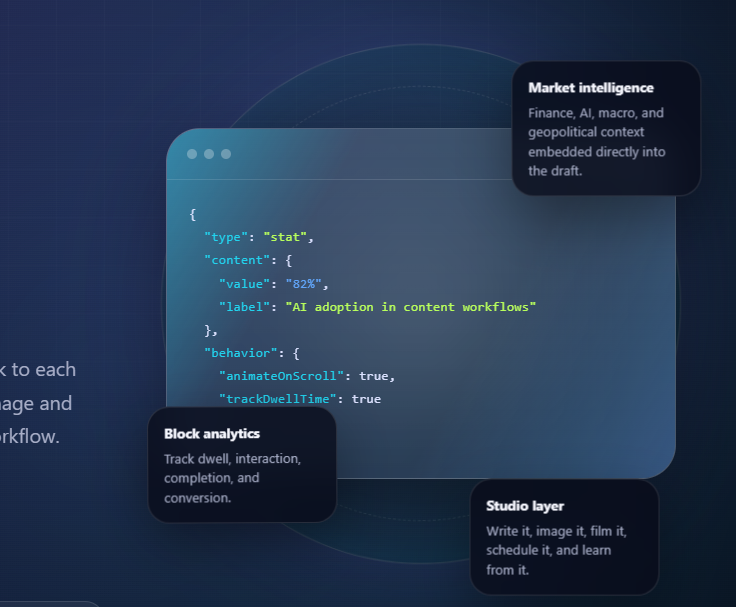
Block content beats HTML and markdown for real-time finance news because data lives in objects, not blobs.
When a financial news platform publishes a Bitcoin price update or a claim about a merger, that information needs to move through multiple systems simultaneously. A mobile app needs it. A trading terminal needs it. A verification oracle needs it. A social network needs it. HTML and markdown treat content as a flat document. Block content treats it as a structured object with metadata attached. That difference determines whether your data can be reused, verified, and kept live or whether it stays locked inside a document.
HTML is a rendering format. It describes how text and images should look on a screen. Markdown is a readable format. It's designed for humans to write quickly without wrestling with syntax. Neither format was built to move data between systems. When you publish a stat inside an HTML article, that number sits inside a paragraph tag alongside editorial text, ads, and navigation code. An AI system trying to extract that number has to parse the markup, guess which number is the actual data point, and hope you haven't embedded it in a sentence like "Bitcoin rose to $82,000 today." Markdown has the same problem in reverse: it's readable but carries no machine-readable metadata about what each piece means. Is that number a price, a prediction, a historical reference, or speculation.
Block content is different. Each piece of information is a discrete object with its own structure. A Bitcoin price block contains a value field, a timestamp field, a source field, and a verification status. A claim block contains the claim text, a confidence score, linked sources, and a slot for community vouching. An AI agent doesn't read the price; it queries the structure. A mobile app doesn't render HTML; it receives a specification for how to display a price block and applies its own native styling. A verification oracle doesn't scrape text; it accesses metadata about who made the claim and what evidence backs it.
Live data is the first place this matters. If you publish a Bitcoin price in HTML, you've published a snapshot. That number was accurate at publication. One hour later, it's stale. Updating it requires republishing the entire article or running a JavaScript overlay that fetches new data and replaces the old text in the DOM. With block content, the price block itself is a reference to a live data source. Change the API endpoint, and every platform displaying that block shows the new price. The block doesn't contain a number; it contains an instruction to fetch and display a number from a trusted source. Finance moves fast enough that snapshots are often wrong before readers see them.
Verification becomes granular with blocks. In a traditional article, you can like or flag the whole thing, but you can't target a specific claim. "This article is accurate, except the third paragraph has bad math." With block content, each claim is individually verifiable. A community oracle can attach a vouch to a specific stat, other users can see that the claim has been verified by a trusted source, and the trust is portable. If that same claim appears in another publication using the same block, the verification travels with it. You're not re-verifying the same fact across five different websites; you're building a graph of what's been verified and by whom.
Responsiveness becomes native instead of responsive. HTML is designed for a desktop-first internet and then made to work on mobile through media queries and breakpoints. A block-based system doesn't suffer from this constraint. A mobile app receives a sequence of blocks and stacks them vertically by default. No CSS calculations. No layout thrashing. No complex media queries trying to guess which version of a layout will fit on this particular screen width. A stat block on a watch shows a number and trend arrow. The same block on a desktop shows the number, trend, historical chart, and source. The design is native to each platform because the platform determines how to render the block, not the publisher.
AI consumption is where the future becomes visible. As news shifts from human readers to AI agents that aggregate, analyze, and summarize information, the difference between unstructured and structured data becomes critical. An LLM reading an article has to parse sentences to figure out what's fact, what's context, what's opinion, what's prediction. It can make mistakes. It can over-weight a throwaway comment because it's phrased emphatically. It can miss important nuance because the nuance is implicit. An AI system consuming block content receives explicit labels for what type of information each block represents. A stat block is always factual and sourced. A prediction block is explicitly a forecast with an associated confidence level. A commentary block is labeled as opinion. The AI doesn't guess. It reads the structure.
HTML and markdown have their place. HTML is fine for static, one-time content where the design is more important than the data reuse. Markdown is the standard for developer documentation because it's readable and simple. But for finance news in particular, where accuracy matters, speed matters, verification matters, and the same data needs to appear in dozens of places updated in real-time, block content is simply better. The data isn't trapped in formatting markup. It isn't hiding in a document waiting to be parsed. It's explicit, typed, and ready to move.