 ViewDAO
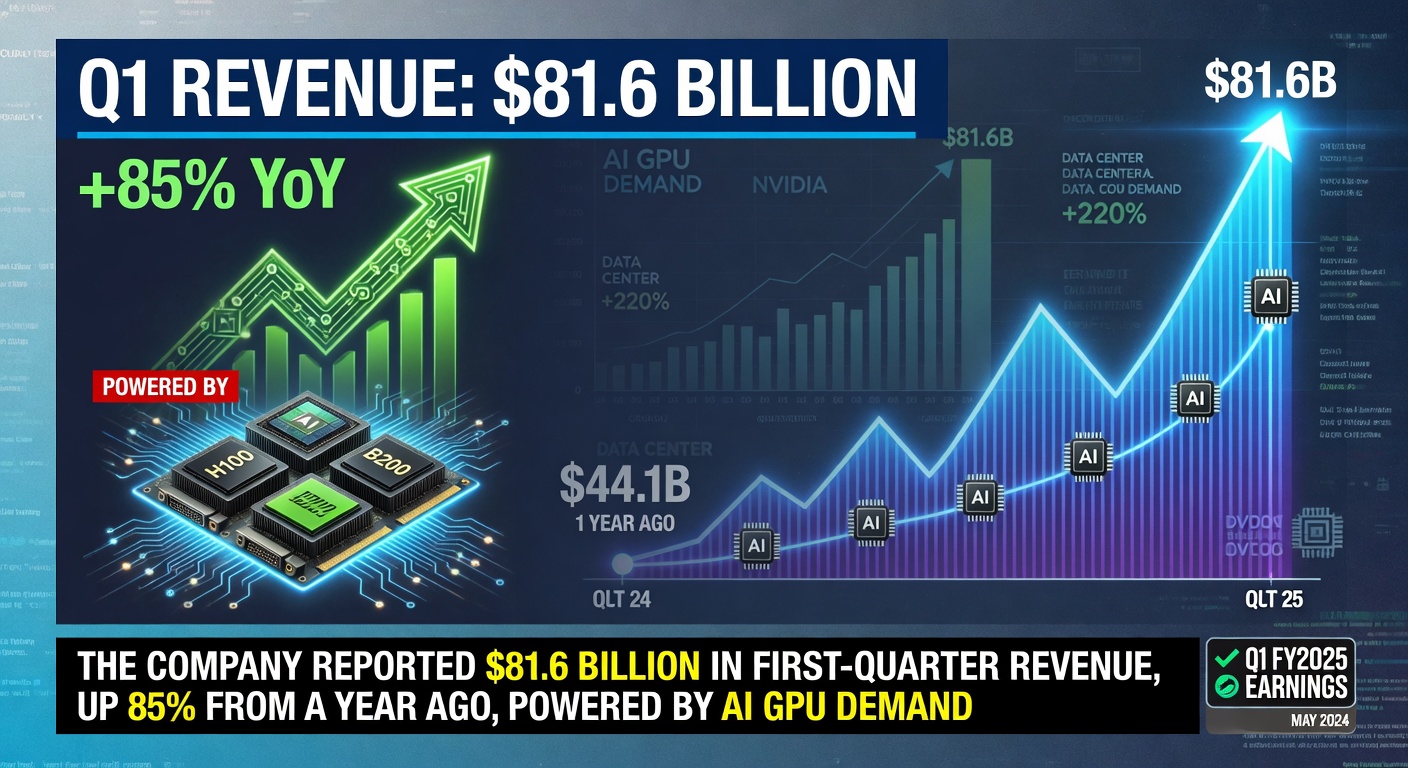
Nvidia delivered $81.6 billion in first-quarter revenue, an 85% year-over-year jump powered by $75.2 billion from data center operations. The AI GPU boom is real. But here's what matters: the stock fell from $223.47 to $219 despite these numbers. That's a sell-the-news move, and it signals something important about how the market prices AI infrastructure plays right now.
The data center segment generates 92% of Nvidia's top-line revenue. That concentration is both its strength and its vulnerability. Demand from hyperscalers building out AI compute remains ferocious. Nvidia guided next quarter to $89.1-$92.8 billion in revenue, a midpoint of $90.95 billion. The company also authorized an $80 billion share buyback and increased its dividend to $0.25 per share, a 2,400% raise. These capital allocation moves signal management confidence in sustained demand.
But valuations matter. Nvidia trades on the assumption that AI capex continues at current pace indefinitely. CEO Jensen Huang called the current buildout 'the largest infrastructure expansion in human history,' which is accurate. What's less certain is whether returns on that capital stack up. The stock's post-earnings dip suggests investors are already pricing in near-term growth and are asking harder questions about medium-term saturation or competition.
Three signals to watch. First, the data center revenue growth rate. At 92% YoY, it's accelerating, but growth deceleration will be the first sign that capex cycles are slowing. Second, gross margins on data center chips. Any compression there signals either increased competition or customer pushback on pricing. Third, customer concentration. Hyperscalers are becoming more aggressive about in-house silicon. Nvidia hasn't disclosed customer concentration recently, but it's a vulnerability if a single customer exceeds 20-30% of revenue.
The practical takeaway for ViewDAO readers: Nvidia's fundamentals remain strong, but the stock's valuation leaves little room for execution errors or macro shifts in AI spending. The sell-off isn't panic. It's recalibration. If you hold Nvidia or are considering entry, treat the next two quarters as the real test. Revenue guides matter less than gross margin trajectory and customer diversification metrics. Watch the earnings calls for management commentary on customer capex plans beyond 2025. That's where the real alpha lives.