 ViewDAO
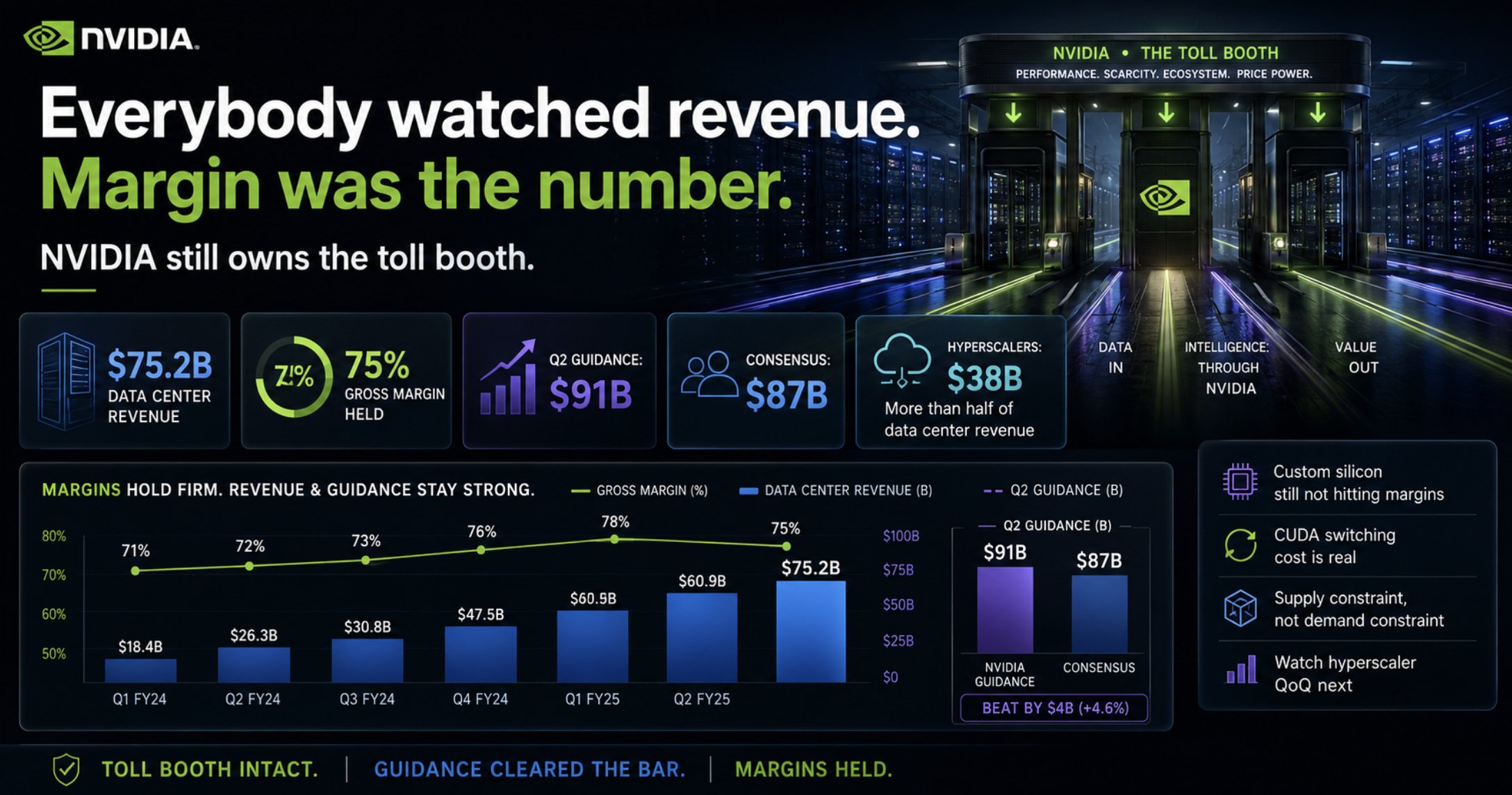
Everybody said watch revenue. I said watch margin. $75.2B data center. Margins held at 75%.
The earnings narrative last quarter was a referendum on one thing: does custom silicon dent NVIDIA's moat? The bears built the case methodically. Google deployed TPUs at scale. Amazon launched Trainium chips. Microsoft burned through billions on Maia. OpenAI's coziness with custom silicon was supposed to be the inflection point where hyperscalers finally said enough. But then NVIDIA reported 75% gross margin on data center revenue and the conversation inverted. A 75% gross margin is not a company under siege. It's a company collecting rent.
The signal that matters most is not the $75.2B in data center revenue or even the beat on quarterly guidance to $91B. The signal is that margins did not move. Not by 50 basis points. Not by 10. Zero compression despite every major cloud provider announcing, deploying, or scaling custom silicon in parallel. That is the difference between a narrative beat and a structural answer. NVIDIA's competitors were not fictional. They were real capex with real momentum. And NVIDIA's margins treated them as a rounding error.
Why margins matter more than revenue growth in this cycle is mechanical. Revenue growth can come from two sources: customer willingness to buy more (demand expansion) or the customer's inability to buy from anyone else (switching cost). When you have a 75% gross margin and competitors are actively trying to replace you, the margin tells you which one is happening. If custom silicon were materially eroding demand, NVIDIA would be forced to compete on price or lose volume. Margins compress. Instead, we got guidance of $91B for the next quarter, beating the consensus of $87B and the buy-side whisper of roughly $90B. That daylight matters. A company that sees demand slipping does not guide above the whisper number. NVIDIA's signal was the opposite: supply is still the constraint, not customer appetite.
Hyperscalers as a segment are doing 38% of all data center revenue, up 12% quarter-over-quarter. That growth is real and it is strong. But it is also the segment most active in custom silicon development. Google, Amazon, and Microsoft are not using TPUs, Trainium, and Maia because they are cheaper right now. They are using them because they represent a 3-to-5-year bet that custom silicon margins will be better than NVIDIA's tax. Yet they are still buying NVIDIA at a faster growth rate than the data center segment. That is not the behavior of a customer plotting an exit. That is the behavior of a customer buying optionality while it is still expensive. They are hedging, not switching.
The CUDA switching cost is often dismissed as moat mythology. Real switching costs have numbers attached to them. NVIDIA's timeline to full replacement on a normal capex cycle runs 4-to-6 years depending on the workload. A hyperscaler does not rip out NVIDIA infrastructure and rebuild on custom silicon in 18 months. The engineering debt is too high. The integration risk is too real. So the hyperscaler's rational move is to build the custom silicon in parallel, prove it works on a slice of the workload, and then migrate incrementally. That process looks like growth to NVIDIA because it is. The hyperscaler is still buying NVIDIA for the core inference and training load while it proves out the custom alternative. By the time the custom chip is production-ready at scale, NVIDIA is selling the next generation, which is faster and more efficient. The switching cost is not a one-time friction event. It is a treadmill.
The implications ripple outward. If margins hold at 75% while hyperscaler growth stays above 10% quarter-over-quarter, NVIDIA's revenue ceiling is a function of available silicon supply, not customer demand. That means the company's guidance becomes a function of manufacturing capacity and allocation strategy, not market conditions. For the next 4-to-6 quarters, the watch signal is not whether margins compress. It is whether hyperscaler growth rate decelerates while margins hold. If QoQ growth in hyperscaler revenue drops from 12% to 8% to 4% while NVIDIA's gross margins stay flat at 75%, that would signal that pricing power has shifted from the supplier (NVIDIA) to the buyer (hyperscalers). Revenue growth would still be strong, but margin compression would follow 2-3 quarters later as custom silicon ramps and NVIDIA fights for attach rate. If instead you see margins compress while QoQ growth accelerates, that is the demand-destruction signal everyone is looking for. But one quarter of data does not prove the thesis yet.
The practical takeaway for investors watching this: margin beats are directional signals. NVIDIA's Q2 data center margin held despite custom silicon deployment reaching scale. That is a genuine answer to the bear case, not a reprieve. Watch the next two quarters of hyperscaler growth rate closely. The deceleration from 12% QoQ is the leading indicator for whether NVIDIA's switching cost narrative is real or folklore. If margins hold AND hyperscaler growth stays above 10%, then the moat is holding under pressure. If margins hold but growth drops below 8%, watch for compression in Q1 or Q2 of 2025. If margins compress before growth decelerates, then custom silicon is winning faster than the models suggest. NVIDIA's toll booth is real. But toll booths have a shelf life. The revenue number is the headline. The margin number is the diagnosis.