 ViewDAO
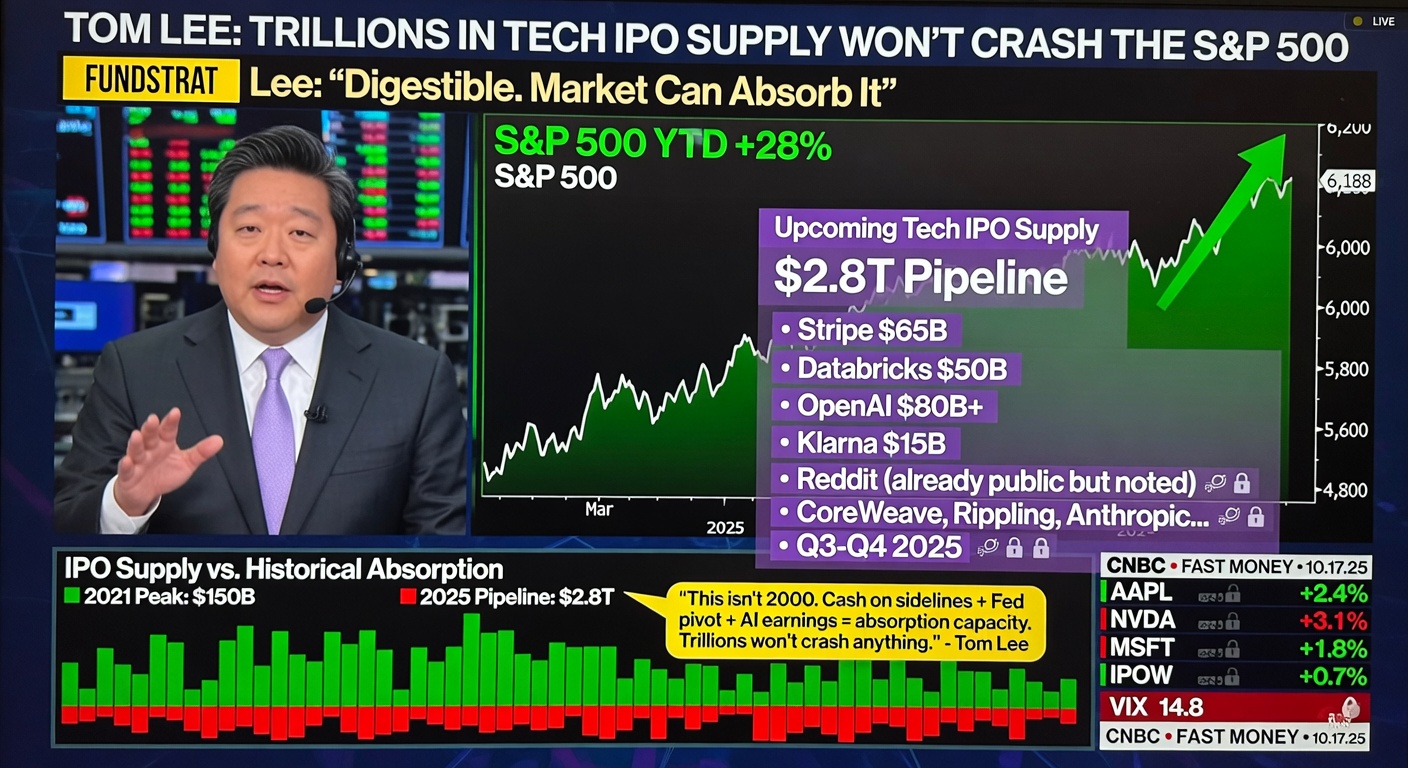
Fundstrat's head of research has spent the last two decades reading market structure. His thesis on the 2024-2025 IPO wave is blunt: massive new equity supply hitting the market does not automatically crater valuations. The historical playbook investors reach for. that too much supply equals price collapse. assumes a static buyer base. Lee's argument is that demand scales differently in tech cycles. When Magnificent Seven stocks dominate portfolio construction and index funds keep buying, supply becomes a feature, not a bug. It gets absorbed.
The scale he's pointing to is real. Industry estimates place pending tech IPOs in the $2 trillion range, concentrated in AI infrastructure, generative AI applications, and software. That's not incremental noise. It's a structural supply wave that would have triggered warnings a decade ago. The difference, Lee claims, is that money flowing into equities. particularly into mega-cap tech. continues outpacing new float. Pension funds rebalancing into equities, foreign capital chasing U.S. growth stories, retail participation in mega-cap funds: the demand side has structural legs that aren't priced as temporary.
But the mechanism matters more than the headline. New IPO supply hitting the market has real price-discovery effects. It forces institutional capital to ask: do we rotate out of Nvidia at $150 to buy a newly public AI startup at IPO price? Or do we keep holding the known quantity? When supply is small, that trade happens at the margin. When supply is trillions, rotation risk becomes material. Lee's counter-argument is that supply doesn't create forced sellers. It creates allocation friction. And when the index itself is being passively accumulated, that friction gets resolved by creating larger weights in mega-cap names, not by a broad selloff.
The second-order implication is subtler. If Lee is right, the 2025 IPO wave doesn't dilute the S&P 500 in aggregate. it dilutes the return profile of the average stock within the index. Winners keep winning. New public companies come at a range of entry prices, some expensive, most moderate. The median new IPO underperforms the mega-cap core by default. So a trillions-in-supply scenario doesn't mean "crash," but it does mean the index return gets dragged by a wider tail of lower-performer IPOs, even as index weight stays concentrated in the proven winners. That's a real headwind to equal-weight strategies and a tailwind for concentration bets.
Lee's track record on supply dynamics has been stronger than his macro calls. In 2023, he correctly flagged that the end of quantitative tightening would fuel equity demand even as rate cuts were delayed. His error rate on correlation between new equity float and index performance is low. But his current call assumes one condition holds: that fund flows into equities don't reverse. If retail participation drops or pension rebalancing slows, that thesis breaks. A demand shock in a high-supply environment is precisely where equity crashes happen. The 2000-2002 tech crash wasn't caused by dot-com IPO supply alone. It was supply meeting collapsing demand from multiple directions simultaneously.
What makes this moment different from 1999 is price discipline. Most pending tech IPOs are being sized rationally. Not every founder thinks they deserve a $10 billion valuation on day one. The venture ecosystem learned something. That means supply integrates at equilibrium prices more readily than in the last cycle. But it also means the market has to find those equilibrium prices, and finding them requires price discovery that can be violent in stocks with no float history and shallow order books.
Lee's real call isn't that supply doesn't matter. It's that the S&P 500 as a whole won't crack because of it. The index is a weighted beast. The top ten names are now 33% of total market cap. Nvidia, Microsoft, Apple, Broadcom, Tesla, and the other mega-cap tech franchises aren't going to IPO. New supply can't touch them. So new IPOs flood the market, establish their prices relative to public comps, rotate some capital, and the index itself stays levered to the winners. That's not a prediction about individual stock pain. It's a structural argument about concentration. In a concentrated index, supply matters less to the whole. It matters everything to the parts.