 ViewDAO
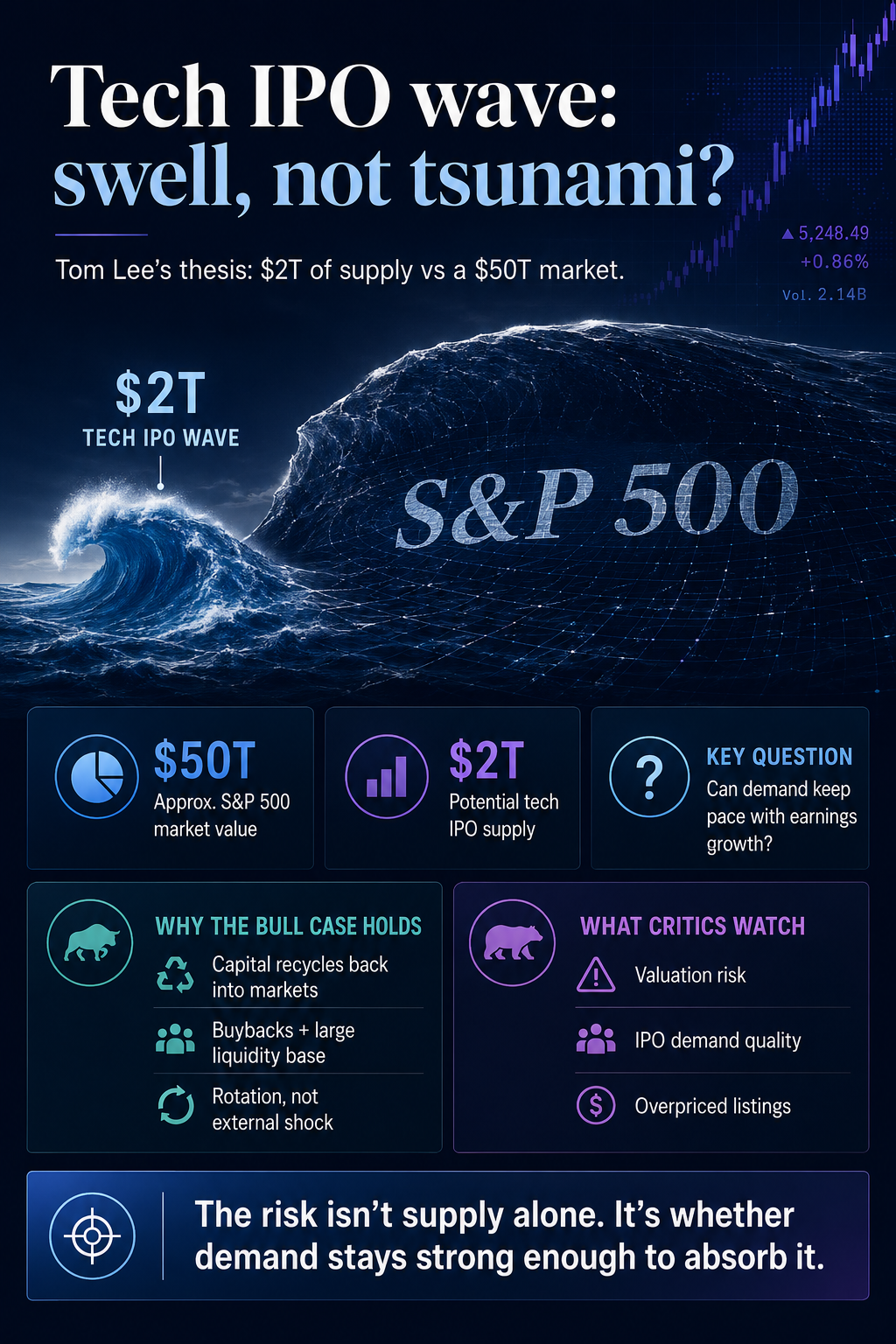
Tom Lee says trillions in tech IPO supply won't crash the S&P 500. The Fundstrat co-founder argues that the bull case for the S&P 500 remains intact despite the looming wave of high-profile tech IPOs like Stripe, SpaceX, and Databricks. Lee points to a simple arithmetic: the market's total capitalization is around $50 trillion. A few trillion in new supply, even if all companies go public at once, represents a fraction of that. The real question isn't whether the market can absorb it, but whether the capital allocation is efficient.
Lee's logic rests on two mechanisms. First, the IPO proceeds don't vanish. They recycle back into the market as newly public companies use the capital to hire, invest, and acquire. Second, the broader money supply remains expansive. The Fed's balance sheet is still large, and corporate buybacks continue to push cash into equities. Lee sees the IPO wave as a rotation within the market, not an external shock. He compares it to the 1990s tech boom, where massive IPO supply coincided with a multiyear rally, not a crash.
Critics point to valuation risk. Many private companies are already priced at high multiples. If the IPO market opens with weak demand, the S&P 500 could face a headwind from overpriced listings. But Lee counters that the strongest companies will price responsibly. He notes that the 2021 IPO glut was followed by a correction, but that correction was driven by inflation and rate hikes, not supply. The current environment, with inflation easing and rate cuts expected, is different.
The bottom line: Lee's argument is not about dismissing risks. It is about understanding scale. The S&P 500 is a $50 trillion ocean. A $2 trillion tech IPO wave is a swell, not a tsunami. The market absorbs supply through demand from pension funds, sovereign wealth, and retail investors who want exposure to the next generation of tech leaders. The real risk is not the supply itself, but whether demand keeps pace with earnings growth.